Negative-Price Protection for Solar
Negative Feed-in Tariffs for Solar Power Possible from January 2027: Profit-Plus Protects PV Operators Free of Charge
Kriens/Immensee, June 11, 2026 – A new market phase begins for operators of photovoltaic systems from 2027. With the new compensation logic adopted by the Federal Council, it will no longer be decisive only how much solar power is produced, but also when it is fed into the grid. From January 1, 2027, grid operators may pass on negative electricity prices to solar power producers. sun2wheel AG and convoltas AG are therefore expanding their “Profit-Plus” product with an automatic and free protection function against negative market prices. “Profit-Plus” is convoltas’ brand name for the solution, which is built on sun2wheel’s bidix technology platform under the hood.
This Federal Council decision changes the economic starting point for operators. Alongside the volume of electricity produced, the active control of the system is gaining importance. “Profit-Plus” detects critical price situations early and automatically reduces feed-in before unnecessary costs arise. Solar power thus remains attractive, but in future it will require closer coordination of production, feed-in, storage, and consumption.
Photovoltaics Enters a New Market Phase
Switzerland is expanding photovoltaics strongly. On sunny days and during low demand, this increasingly creates situations in which a lot of electricity flows into the grid at the same time. As a result, feed-in compensation will in future be more strongly influenced by the market price at the time of feed-in. What was previously not noticeable for operators is thus becoming a relevant factor in system operation. Particularly for larger systems above 150 kWp, the economic value of solar power can increasingly depend on whether it is fed in at the right moment.
From Passive Feed-in to an Actively Controlled Energy System
Photovoltaic systems were long operated according to a simple principle: produce, feed in, get compensated. This model is changing fundamentally, and a new era of solar energy is dawning. With negative electricity prices, declining feed-in tariffs, and new requirements for grid stability, active control is becoming the central prerequisite for economical operation: in future, a PV system must therefore not simply produce and feed in as much electricity as possible, but be able to respond flexibly to market prices, grid situations, and consumption options.
Automatic Protection Against Negative Market Prices
“In future, a PV system needs more than an inverter and a meter. It needs a digital operating system that recognizes when feed-in makes sense and when flexibility creates more value,” says Sandro Schopfer, CEO and co-founder of sun2wheel. “This is exactly where we come in with Profit-Plus.”
The new free protection function of “Profit-Plus” monitors relevant market signals and detects imminent negative-price phases early. When necessary, the feed-in of the integrated PV systems is automatically and temporarily reduced. As soon as the market situation normalizes, the system independently returns to regular operation. The intervention is targeted, automated, and requires no manual effort from the operator. Market monitoring, forecasting, and control run entirely in the background. This means system owners do not have to carry out their own market analyses or react themselves to short-term price signals.
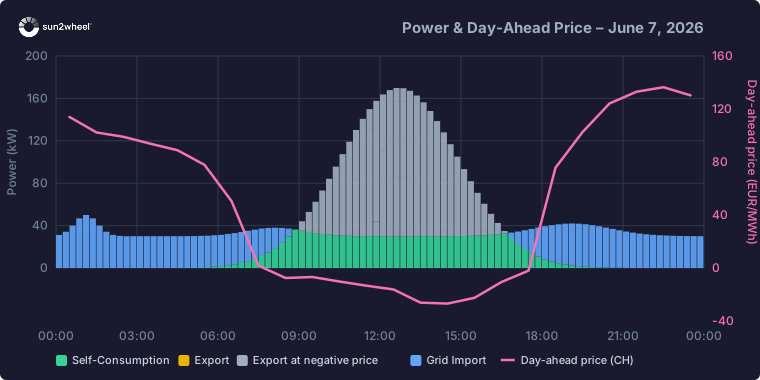 Example daily profile for June 7, 2026 with the Swiss day-ahead price (pink line). During the hours with a negative price (line below the zero baseline), the system is curtailed to a level that covers only self-consumption and reduces export to zero – the energy that would otherwise be exported is shown in grey. Price data: Energy-Charts (CC BY 4.0).
Ideal for Systems Without a Battery
The solution is particularly attractive for operators who do not yet want to install a battery, or who are still waiting to do so. “Profit-Plus” gives them effective protection against negative market prices without any investment, bridging the gap until a battery becomes economical or available. Where a battery is already in place, the two approaches complement each other seamlessly: surplus solar power is first stored in the battery, and curtailment only kicks in once the battery is fully charged and a surplus still remains during negative prices. This way, feeding in energy at a negative price is ruled out in every case.
Risk Protection Follows Additional Revenue
Already today, “Profit-Plus” bundles photovoltaic systems into a virtual power plant and markets their flexibility on the Swiss balancing energy market. Operators can thereby achieve additional revenue of around CHF 10 per installed kilowatt. With the new protection function, this approach is expanded: flexibility no longer serves only as a source of revenue, but also as protection against new market risks.
“With Profit-Plus, we turn flexibility into concrete economic added value. The new protection function is the logical further development of this principle: it reduces risks and at the same time creates the basis for deploying PV systems even more actively in the electricity market,” says Fabian Gloor, Sales Director at convoltas.
No Additional Effort for Operators
The negative-price protection function is automatically and free of charge active for existing and new “Profit-Plus” customers. Additional hardware or a separate configuration effort is not necessarily required. The prerequisite is the technical integration of the system into the Profit-Plus platform. This creates a double benefit for operators: they can continue to market flexibility and at the same time receive automatic, free protection against unfavorable feed-in situations.
Flexibility Becomes a Security and Revenue Component
The collaboration between sun2wheel and convoltas in the “Profit-Plus” product shows how photovoltaic systems can be prepared for the new market logic. Intelligent control protects against negative market prices, enables additional revenue, and simultaneously supports the stability of the power system. This makes flexibility the new security and revenue component of the Swiss solar industry.
What Negative Electricity Prices Mean for PV Operators
Negative electricity prices arise when more electricity is offered than demanded on the electricity market. This can be the case particularly on sunny days with high solar power production and simultaneously low consumption. With the new compensation logic, the timing of feed-in becomes more important: those who feed in without coordination during low or negative market prices may suffer economic disadvantages. At the same time, opportunities arise for systems that can be controlled flexibly.
Intelligent systems like “Profit-Plus” detect such situations automatically. They can temporarily reduce feed-in, make electricity usable locally, or market flexibility on the balancing energy market.
About sun2wheel AG
Founded in 2020, sun2wheel AG develops energy management systems for the intelligent networking of decentralized energy resources. The platform optimizes self-consumption and load management while simultaneously enabling the marketing of flexibility in virtual power plants. sun2wheel connects PV systems, storage, and e-mobility into an integrated energy ecosystem. www.sun2wheel.ch
About convoltas AG
convoltas AG is a Swiss energy general contractor that plans, builds, and operates large-scale photovoltaic systems, battery storage, electromobility solutions, and holistic energy systems. Since 2019, convoltas has developed into a leading provider in the renewable energy sector, offering a complete value chain from project development to monitoring. The focus is on scalable, economically attractive, and grid-serving energy solutions for industry, commerce, and real estate portfolios. www.convoltas.ch